
 Język / Language


- Dried Flowers Bouquets
- Dried Flowers
- All products
- Anafalis
- Amaranthus
- Banksia
- Broom Bloom
- Bell Cup
- Brunia
- Cotton
- Celosia
- Nigella
- Gypsophila
- Glixia
- Gomphrena
- Hill Flower
- Hydrangea
- Helichrysum
- Wild Fennel
- Billy Buttons (Craspedia)
- Carthamus
- Achillea
- Mintola
- Dried Lily
- Dried Lotus
- Palm cup
- Shola Flowers
- Lavender
- Flax
- Lepidium
- Lonas
- Lunaria
- Poppy
- Mimosa
- Delphinium
- Thistle
- Pepper
- Pressed flowers set
- Protea
- Preserved Roses
- Echinops
- Acroclinium
- Statice
- Ammobium
- Dried Bouquets
- Dried flowers cake topper
- Dried grasses and gains
- Dried leaves
- Preserved Flowers
- Dried flowers wreaths
- Exotic dried flowers
- Florist Accessories
- Dried flowers colours
- Polish dried flowers
- E-gift card
- Promotion
- Outlet
- New products
- Promocje
Brunia
Brunia, also known as brunia albiflora or gray brunia, is a plant native to southern Africa. Its most distinctive feature is the small, gray balls located on thin twigs. The globules are the fruiting bodies of the brunia, which are suitable for drying.
Brunia natural 5 pcs. - dried flowers
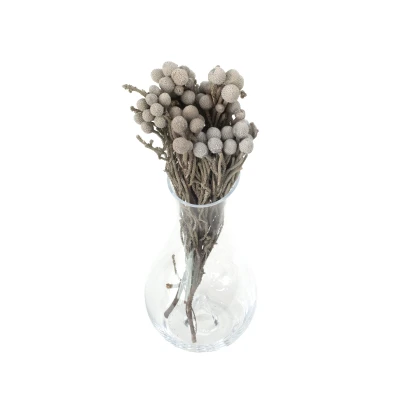
Brunia natural 5 pcs. - dried flowers.
Availability: mała ilość
Brunia bleached 5 pcs. - dried flowers

Brunia bleached 5 pcs. - dried flowers.
Availability: Wyprzedany
Brunia, exotic flower worth acknowleding
Brunia is a shrub in the Bruniaceae, or heath-like plant family. The plant includes 81 species found wild in southern Africa. Brunia grows in the fynbos formation, i.e. it occurs between South African mountain slopes and coastal lowlands is the equivalent of the Mediterranean maquis. In Poland, we use dried brunia primarily in floriculture and handicrafts.
Brunia - characteristics
Brunia shrubs grow up to 3m tall. Small, twisted leaves cover the branching stems. Flowers on the tops of the stems form characteristic clusters of silvery color from 1 to 15mm. In this form, the brunia is cut and destined for drying. After flowering, fruits appear in the form of bursting or unbursting pouches surrounded by a calyx.
Brunia - occurance and cultivation
Brunia is endemic to the southern reaches of Africa, growing throughout the Cape Province. Few species are found in the east in the KwaZulua-Natal Province. The harsh conditions in which brunia naturally occurs have made it well adapted to droughts and even fires. Brunia grows best in sandy-gravel soil, and requires a position with strong sunlight. Due to the specific conditions necessary for the plant to grow properly, brunia is not found in other parts of the world and is not grown as an ornamental plant.
Brunia methods of use - floristry and handicraft
Dried brunia shoots are mainly used in floristry for their aesthetic qualities. Most often we can meet the plant from southern Africa as an addition to dried bouquets of flowers, reeds and exotic compositions. The interesting color of the dried bruni - gray-silver - makes the plant blend well with other dried plants. It is also eagerly used by florists in bouquets of live flowers, such as hydrangeas, levconias and roses. In the case of dried flowers, brunie will most often meet in the company of blanket (Helichrysym), sprigs of cotton bower, and other species of dried exotic: banksia, protea, lotus flower. Small, spherical inflorescences of brunia will be an ideal addition to garlands and decorations of dried flowers for hair. If we want brunia to decorate our interiors, it is best to simply place it in a simple glass vase.